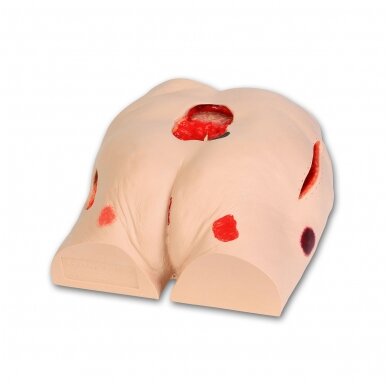


Seymour II™ pragulų priežiūros simuliatorius
Kodas: 3B Scientific 1009798Kaina 94912 € su PVMPrekę turime sandėlyje. Užsakius ir apmokėjus šiandien iki 14 val., pristatytume kitą darbo dieną.
Šiuo metu prekės nėra sandėlyje. Numatomas pristatymo laikas nurodytas žemiau.
Pateikus užsakymą, susisieksime su Jumis ir informuosime apie tikslų numatomą užsakymo pristatymo laiką.
Šiuo metu prekės nėra sandėlyje. Numatomas pristatymo laikas nurodytas žemiau.
Pateikus užsakymą, susisieksime su Jumis ir informuosime apie tikslų numatomą užsakymo pristatymo laiką.
GamintojasPristatymo laikas3-6 savaitės-
Informacija apie prekę Prekės kodas 1009798 [W46500/1] Svoris2.51 kg Išmatavimai 30.5 x 30.5 x 15.2 cm Ženklas VATA Gamintojo kodas: 910
Seymour II™ Wound Care SimulatorThe Seymour II™ Wound Care Simulator has been redesigned and now made with a new flexible, life-like material that permits the application and easy removal of dressings, without leaving an adhesive residue. Still the most comprehensive model of its kind, molded from a 74-year-old patient, looks and feels like the real thing. Displaying the following pressure ulcers* (NPUAP 2007 - National Pressure Ulcer Advisory Panel): Stage I, Stage II, Stage III with undermining, tunneling, subcutaneous fat and slough, deep Stage IV with exposed bones, undermining, tunneling, subcutaneous fat, eschar and slough. Also shown are a suspected DTI (Deep Tissue Injury), unstageable full eschar/slough wound, and a dehisced wound. The Stage III and Stage IV are positioned so that a “bridging” dressing for use with a vacuum assisted closure and negative pressure wound therapy devices can be demonstrated and practiced. This model makes it possible to visualize and understand the differences in wounds. Great care has been taken to color each wound just as you would see it on a patient. You are able to demonstrate and practice wound cleansing, classification, staging, and assessment, as well as the measurement of wound length, depth, undermining, and tunneling. The positioning of the wounds permits multiple dressings to be demonstrated at the same time.
Prekių krepšelis
Krepšelis tuščias.


